How to prepare for your first indoor FPV drone racing session
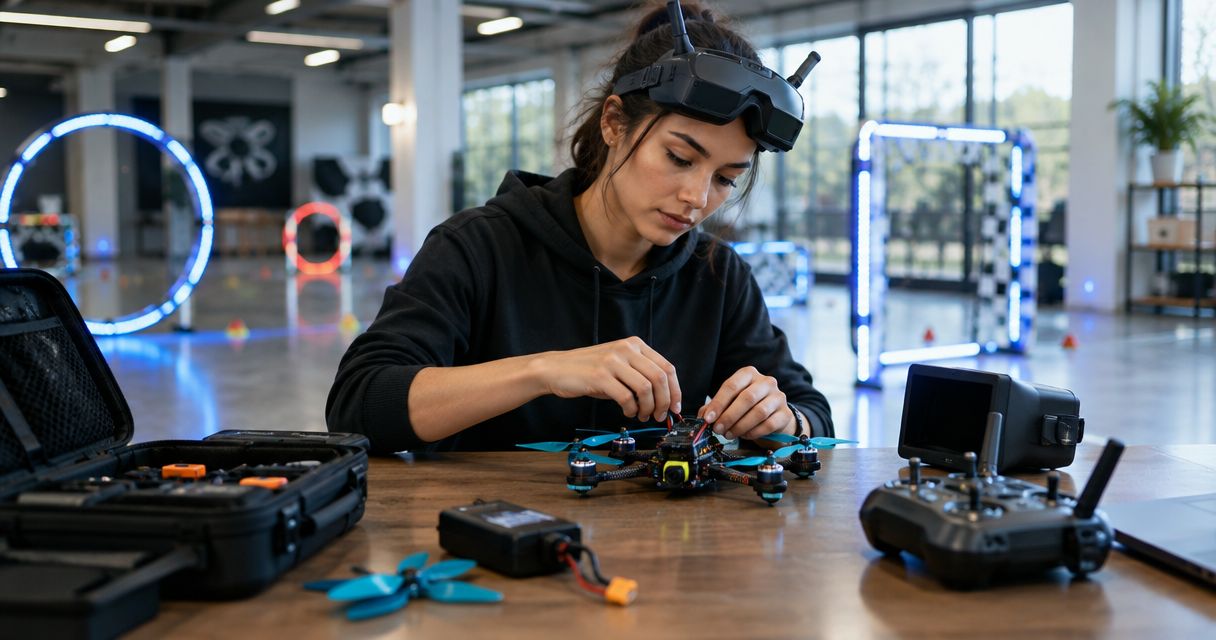
Your first indoor FPV drone racing session goes smoother when the prep happens before you ever clip in a battery: log simulator time, pick goggles that actually fit your face, and dress like you're about to duck and pivot through LED-lit hoops. The part most beginners skip is screen time — stick memory built in a simulator is what keeps your first real flight from turning into a 15-second battery dump into a wall. Nobody expects you to thread a glow-gate on lap one; they expect you to show up calm, charged, and ready to crash on purpose a few times.
Why this matters
FPV stands for first-person view — goggles put you inside the quad's nose camera instead of flying from the ground with your thumbs on a controller and your eyes tracking the sky. That swap costs beginners a few minutes of disorientation the first time the picture snaps into their full field of view, which is why simulator reps matter more than raw reflexes. If any of the jargon in this guide is new — Angle mode, Acro mode, AIO board (the single circuit board that runs the flight controller and motor speed controllers) — the FPV drone racing for beginners complete guide breaks down the full vocabulary before race day.
Walking in unprepared means burning your limited stick time fighting nausea and fumbling with goggle straps instead of chasing your first glow-gate, the LED-lit hoop that marks a lap on an indoor track. A little prep the night before is the difference between leaving grinning and leaving early.
TL;DR
- Log simulator time before your first indoor FPV drone racing session — stick memory beats raw reflexes.
- Pick FPV goggles that fit your face shape; a bad seal ruins focus faster than bad flying does.
- Wear closed-toe shoes and clothes you can pivot in — glow-gate tracks mean ducking and turning fast.
- SquadFlight's current Las Vegas meetups run simulator-first sessions ahead of the full indoor gym opening.
- Arrive hydrated and not starving; goggle motion sickness hits harder on an empty or heavy stomach.
How do you prepare for your first indoor FPV drone racing session?
-
Log simulator time first. Beginner curriculums in 2026 still start the same way they did a decade ago: hours on a FPV drone simulator for beginners before a real quad ever leaves the ground. Sim time builds the stick memory that keeps your first live flight from ending in a wall.
-
Learn the Angle-to-Acro ladder. Angle mode self-levels the quad — let go of the sticks and it rights itself. Acro mode is full manual with zero auto-correction, and it's what every experienced racer flies. Spend your prep time comfortable in Angle before you worry about Acro.
-
Sort your gear the night before. If you're bringing your own micro quad, charge every battery pack and label any cell that's swollen or underperforming. If you're attending a current SquadFlight meetup or garage-lab training night, gear policies vary by event — confirm with the organizer whether loaner quads are available rather than assuming.
-
Dress for a glow-gate track. Closed-toe shoes, clothes you can crouch and pivot in, hair tied back before goggles go on. Skip loose scarves or dangling jewelry near propellers.
-
Eat light, hydrate, arrive early. A heavy meal plus goggle motion sickness is a rough combination. Arriving 15-20 minutes ahead of any beginner session gives you time for a safety rundown without rushing straight into goggles.
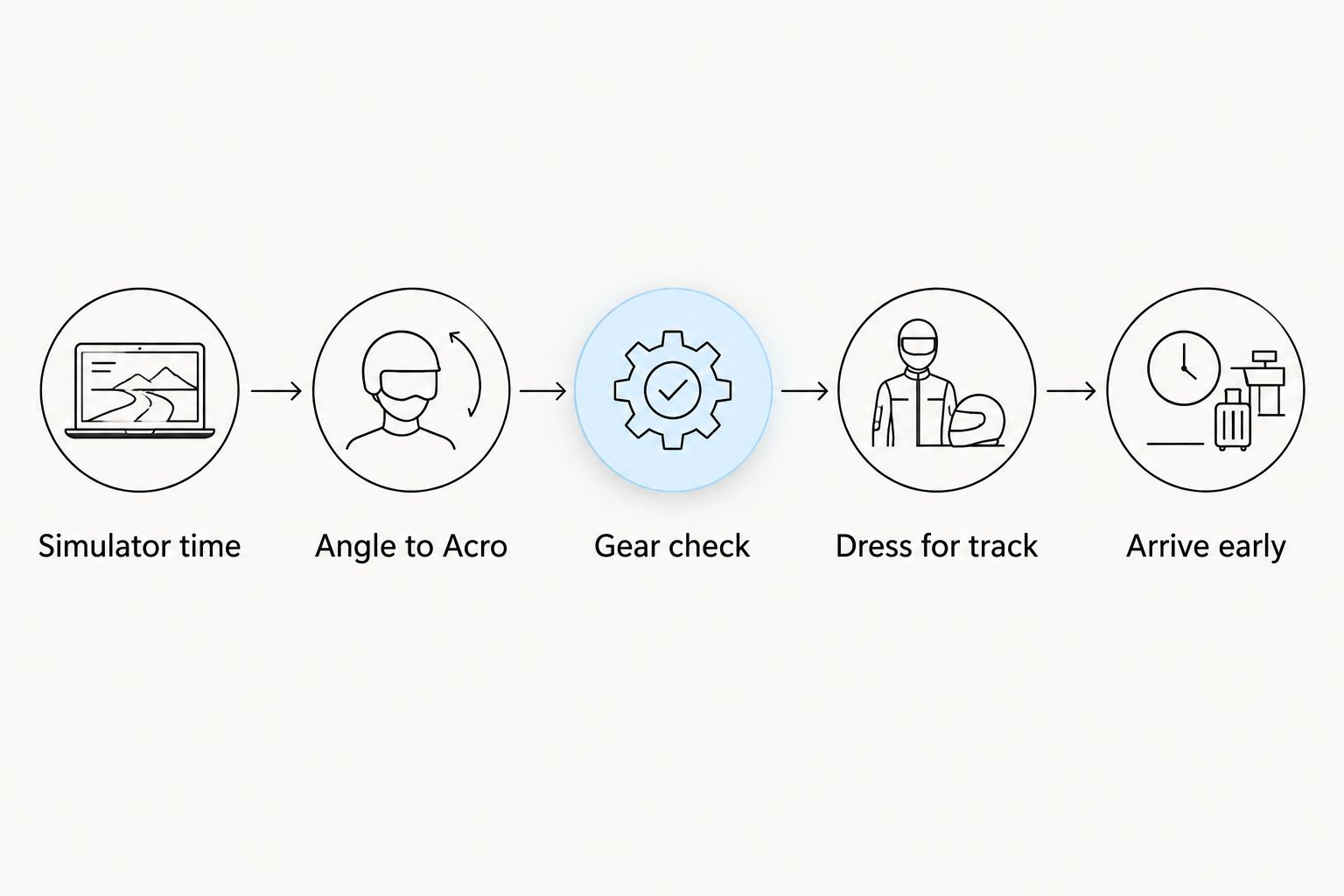
Simulator time comes before gear, and gear comes before goggles go on.That order matters more than it looks. Pilots who skip straight to step 3 — buying gear before logging any sim time — tend to burn through their first few sessions fighting the controls instead of learning the track.
Gear checklist for your first indoor FPV session
Goggle fit decides more of your first session than the quad does. FPV goggles for beginners in 2026 split mostly between analog 5.8GHz feeds and newer digital systems — both work fine for a first session, but a bad foam seal that lets in side light will wreck your focus faster than any crash.
-
Goggles that seal around your eye socket — gaps let in ambient light and break immersion.
-
A charged battery pack or two if you're bringing your own quad — current meetups vary on whether loaner gear is available.
-
Closed-toe shoes and clothes you can crouch in — glow-gate tracks mean ducking under and pivoting around hoops.
-
A hair tie — goggle straps and loose hair don't mix.
-
A light layer — indoor tracks run climate-controlled and cooler than outdoor Las Vegas heat.
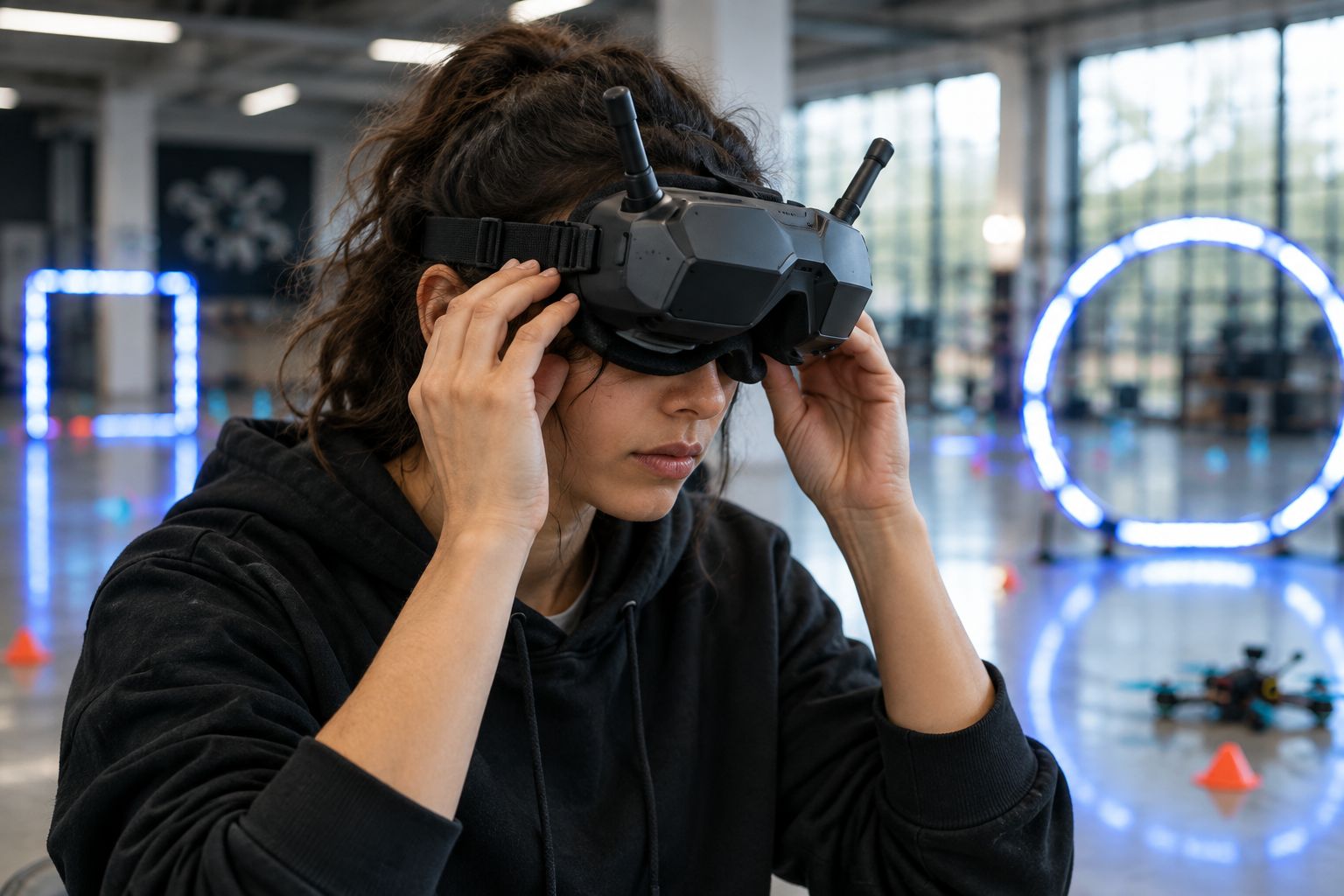
Goggle seal matters more on session one than the quad you're flying.
What determines how ready you feel on race day
-
Simulator hours logged before the session — the single biggest factor in how fast the first flight feels natural.
-
Goggle fit and field-of-view comfort — a loose seal causes distraction and nausea independent of flying skill.
-
Angle versus Acro familiarity — knowing which mode you'll fly in removes a layer of in-session confusion.
-
Prior gaming or manual-control experience — stick-based game experience transfers more than you'd expect.
-
Sleep and hydration the night before — goggle disorientation compounds fast on no sleep or an empty stomach.
-
Track format familiarity — glow-gate spacing and gate count differ by venue, so ask what the layout looks like beforehand.
“If you can't land smoothly in Acro mode in the simulator, you're not ready to fly it for real yet.”
Do I need to own an FPV drone before my first session?
Not necessarily — but don't assume gear is provided either. Current SquadFlight sessions run as Las Vegas meetups and garage-lab training, not inside the finished climate-controlled gym yet, so loaner-quad policies vary by event. Confirm with the organizer ahead of time, or plan to bring your own entry-level micro quad if you want to guarantee you're flying.
Is FPV drone racing hard to learn for a first-timer?
There's a real learning curve, but Angle mode removes the hardest part of flight — self-leveling — so you build stick memory before Acro mode's full-manual control ever enters the picture. Most first-timers compare the mental load to go-karting more than to video games, since the quad reacts to weight and throttle like a vehicle, not a joystick icon on a screen. The curve flattens fast once simulator reps are logged going into a session.
What should I wear to an indoor FPV session?
Closed-toe shoes, clothes you can crouch and pivot in, and hair tied back before goggles go on — skip loose scarves or jewelry near propellers. Indoor FPV venues run climate-controlled, so bring a light layer even heading into a Las Vegas session in 2026 heat.
Find a SquadFlight training session
Simulator-first sessions and garage-lab meetups running now in Las Vegas.
See training optionsFollow SquadFlight updates
FAQ
What should I bring to my first indoor FPV drone racing session?
Bring closed-toe shoes, a light layer for the air-conditioned track, and your own micro quad if you plan to fly one you already own. For current SquadFlight meetups, confirm loaner gear availability with the organizer ahead of time.
How long does it take to learn FPV drone racing?
Most beginners get comfortable in Angle mode within a few simulator sessions, then start attempting Acro mode once stick inputs feel automatic instead of deliberate. The exact timeline depends on how much simulator time gets logged before goggles ever go on for real flight.
Is FPV drone racing safe for beginners?
Indoor FPV tracks remove outdoor variables like wind and traffic, and beginner sessions typically start in Angle mode at slower speeds before progressing further. Safety setup and gate spacing vary by venue, so ask the specific track about its beginner configuration.
Do I need FPV goggles or can I use a phone screen?
FPV goggles are standard because they block peripheral light and deliver a full field-of-view immersion a phone screen can't match from arm's length. Beginner-friendly goggle options exist at lower price points if you're not ready to invest in top-tier gear.
What's the difference between Angle mode and Acro mode?
Angle mode self-levels the quad so it rights itself when you let go of the sticks, while Acro mode gives full manual control with no auto-correction. Nearly every beginner curriculum starts in Angle and migrates to Acro once stick memory builds.
What's a Tiny Whoop and do I need one for my first session?
A Tiny Whoop is the beginner-friendly class of micro FPV quad, usually under 250 grams and built with prop guards for indoor crashes. You don't need to own one for your first session, but many pilots eventually buy their own once simulator time clicks.
Is FPV drone racing better learned indoors or outdoors?
Indoor FPV removes wind and GPS drift from the equation, letting beginners focus purely on throttle and stick control without weather variables. Outdoor flying adds unpredictable factors, which is why most training curriculums start indoors heading into 2026.
One last thing
Most first-session wipeouts aren't bad flying — they're bad neck movement. Turning your head fast inside goggles spikes motion sickness faster than any crash does, so keep head turns slow and deliberate for your first few battery packs. By the second or third pack, most pilots stop noticing it entirely, and that's usually the moment a first-timer starts actually enjoying the glow-gate chase instead of surviving it.