FPV Drone Racing for Beginners: 2026 Verdict & Guide
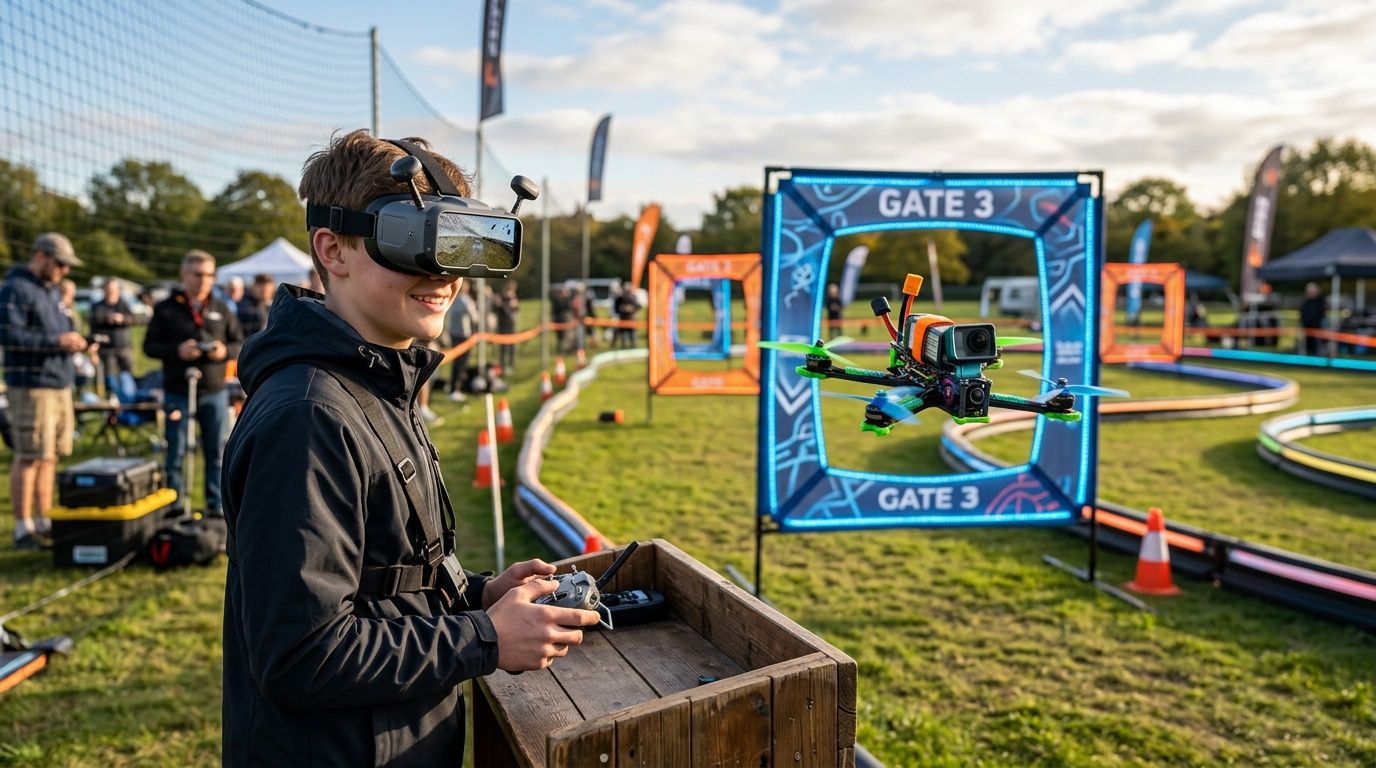
FPV drone racing for beginners is the on-ramp into first-person-view flying, built around simulator reps and Angle-mode control before you risk a real frame on a live gate. New pilots need a protected space to crash, rebuild, and repeat — not a field full of veterans ripping 5-inch freestyle at full Acro while you're still learning which stick is throttle.
TL;DR
- FPV drone racing for beginners starts on a simulator in Angle mode so you can build control before risking gear.
- Micro-FPV quads under 250g skip FAA registration only when flown under the recreational exception; other operations follow different rules.
- SquadFlight is building an indoor Las Vegas micro-FPV gym; current training and meetup sessions are announced separately.
- Sim time, a controlled track, and a squad to fly with matter more than a race-tuned frame during beginner practice.
- Move from Angle to Acro only once you can hold a clean gate line on sim without over-correcting.
Why FPV drone racing matters for beginners
Getting off the ground as a beginner, can be a struggle. Be careful not to learn on the wrong gear in the wrong place. A 5-inch freestyle quad at a windy outdoor field is a bad classroom — every crash costs money and every gust ruins your line. You only flew for 10 seconds before you're back on the workbench fixing the latest issue.
An indoor, climate-controlled space changes the math. SquadFlight is building a micro-FPV indoor-park in Las Vegas with planned LED glow-gate tracks, parks for freestyle and simulators. Until the permanent venue opens, current training and meetup sessions are announced separately on SquadFlight's site.
Learn the vocabulary before you touch a stick
FPV has its own language, and half of beginner confusion is just not knowing the words. Get these down before you shop for gear.
-
Angle mode: self-leveling flight, the beginner default
-
Acro mode: full manual control, no auto-leveling — the "real" FPV skill
-
Mode 2: throttle on the left, used by 87% of pilots (Source: https://ceur-ws.org/Vol-2617/paper6.pdf )
-
AIO board: an all-in-one flight controller, ESC, and VTX on one board
-
Glow-gate: an LED-lit racing gate used on indoor and night tracks
-
VTX: the video transmitter sending your camera feed to your goggles
Train on a simulator first, not a real quad
Simulator practice gives you low-risk reps before you put a real quad in the air. Put in your reps here before you spend money on carbon fiber.
-
Log at least a few weekly sessions in a free or low-cost FPV simulator. We suggest Drone Racing League sim for absolute beginners, they have an easy to follow step by step tutorial.
-
Velocidrone is great, if you think self guided is what you want.
Build your throttle control early, it is your path to smooth flight Practice gate-to-gate lines, not just hovering Track your crash count — it should drop week over week Switch to Acro mode on sim once Angle feels boring, acro is your goal, start in angle, build skills slowly Slow is smooth, smooth is fast Mirror your real transmitter's stick layout in sim settings
Build your beginner gear checklist
Skip the race-tuned freestyle build. Beginners need something forgiving and cheap to repair.
-
Buy an RTF kit from BetaFPV, I suggest the Cetus Pro it is well suited to indoor flying it includes: A beginner tuned quad
-
Goggles with analog reception
-
2 batteries matched to your frame and electronics
-
Spare props — you'll snap them, that's normal
-
You can get them from Amazon or from SquadFlight's training class.
Register your drone before you fly outdoors
Registration requirements depend on weight and how you fly, so check the FAA's current rules before any outdoor session.
-
Check whether your drone and flight type require FAA registration
-
If registration is required, mark the registration number on the drone body
-
Check local no-fly zones before flying outdoors
-
Follow venue safety rules indoors and check FAA and local requirements before flying outdoors
Find or build a track with real gates
Hovering in your backyard doesn't teach racing lines. Gates do.
-
LED glow-gates give you a visible line to chase, day or night
-
Indoor tracks remove wind as a variable while you're learning
-
Climate-controlled spaces mean no rained-out sessions
-
Timing gates (where available) turn practice into a measurable lap
Fly with a squad, not alone
Solo practice plateaus fast. Feedback from pilots ahead of you fixes bad habits before they set.
-
Join community fly nights instead of practicing solo every time
-
Get an actual pilot number and track your own progress against it
-
Ask for line critique after every session, not just "nice flying"
-
Trade crash stories — everyone's been the first to crack a frame
Graduate from Angle to Acro
This is the actual "Fraud to Squad" moment — the point where you stop faking it and start flying.
-
Hold altitude on Acro without drifting before adding gates
-
Add throttle punch-outs once level flight feels boring
-
Increase your rates gradually, not all at once
-
Attempt your first flip only after clean, repeatable gate passes
Beginner training options compared
Option Best for Key limitation
Home simulator practice Zero-risk stick time before buying gear No real air feel, no gate timing
Outdoor park flying Free flying space, real wind conditions Weather-dependent, FAA airspace rules apply
Planned indoor FPV sessions (SquadFlight) Beginners who want glow-gate tracks and coaching without weather delays The permanent venue is not open yet
Local FPV club races Community feedback and structured events Beginner coaching and pacing vary by event
Verdict: sim time gets you stick skills for free, but an indoor glow-gate track is what actually teaches FPV drone racing for beginners — gates, lines, and squad feedback don't happen on a couch.
Squad up for your first gate run
Follow current Las Vegas training and meetup sessions while the permanent venue is being built.
Common mistakes beginners make
-
Buying a race-tuned 5-inch frame first — crashes shred a build fast when you haven't logged sim hours yet
-
Skipping Angle mode entirely — jumping straight to Acro without leveling on sim first just means more broken props
-
Flying outdoors without checking the rules — registration depends on weight and whether the flight qualifies for the recreational exception
-
Practicing alone with no gate feedback — line accuracy and consistency are harder to judge without feedback
-
Ignoring prop size for the space — 5-inch freestyle props don't belong on a track built for micro-FPV gates
FAQ
What's the best way to start FPV drone racing for beginners?
Start on a free flight simulator in Angle mode, then move to a micro-FPV quad under 250g once you can hold a gate line on sim. Real air time on an indoor glow-gate track comes next, before ever attempting outdoor Acro flying.
Is Angle mode or Acro mode better for beginners?
Angle mode self-levels the drone when you center the sticks, which simplifies early practice. Acro mode gives you full manual control, so move to it gradually after you can repeat clean lines in Angle mode.
How much does FPV drone racing gear cost to start in 2026?
Costs vary by build and goggles chosen, so check current pricing directly with a retailer before buying. A small micro-FPV frame with compatible electronics is a practical entry point; compare current retailer pricing before buying.
Do I need to register my drone with the FAA?
FAA registration depends on the drone's weight and how it is flown. The under-250g exception applies only to qualifying recreational flights, so check the FAA's current rules before flying outdoors.
Can I learn FPV drone racing indoors?
Yes, controlled indoor spaces remove wind and weather from practice. SquadFlight is building a Las Vegas micro-FPV gym around this model, but the permanent venue is not open yet.
How long does it take to get good at FPV racing?
Progress depends on consistent simulator and track practice, not simply how long you have owned a quad. Move to harder gate lines only when you can repeat the current line cleanly.
What size drone is best for beginner racing?
A small ducted micro-FPV quad suited to indoor flying is a practical beginner choice. Compared with a 5-inch freestyle frame, it is easier to use in a controlled indoor practice space.
Is FPV drone racing dangerous for beginners?
FPV flying still requires eye protection, prop guards where appropriate, a controlled space, and clear venue rules. Simulator practice reduces gear damage while you learn the controls, but it does not remove flight risk.
One last thing
Small ducted micro-FPV quads are popular for indoor practice because they are easier to contain than 5-inch freestyle frames. Beginners should still use a controlled space, appropriate protective equipment, and the venue's safety rules in 2026.