FPV racing drones ranked by speed in 2026
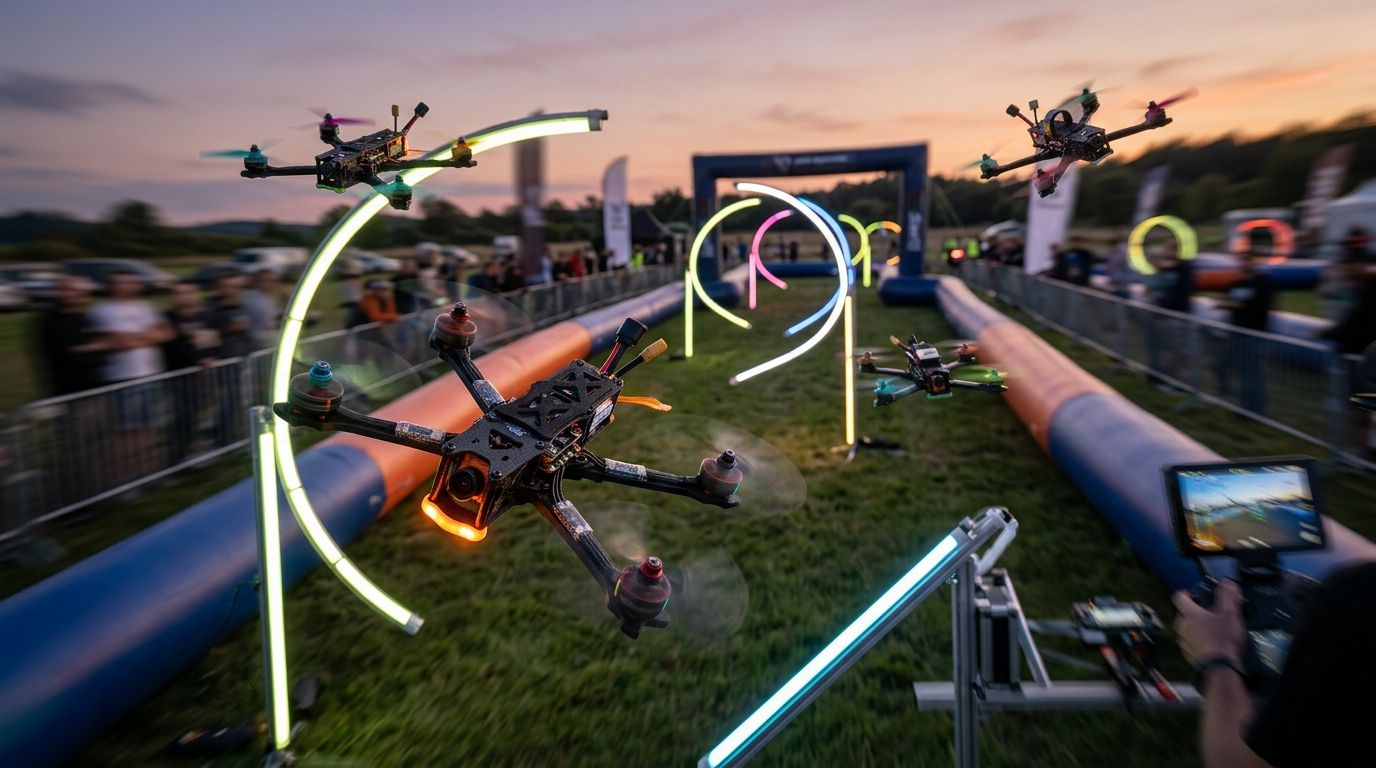
For FPV racing drones ranked by speed in 2026, the order by typical speed potential is 5-inch open-prop racing quad first, 3-inch open-prop racing quad second, and 65 mm ducted Tiny Whoop third. These are drone-class rankings, not measured top speeds: the fastest class is not the best choice for every track or pilot.
TL;DR
- FPV racing drones ranked by speed: 5-inch open-prop quads lead on typical speed potential, ahead of 3-inch quads and 65 mm Tiny Whoops.
- A 5-inch racing quad is best for pilots choosing speed on a suitable outdoor course.
- A 65 mm Tiny Whoop is the better starting point for indoor micro-FPV and learning to hold a race line.
- SquadFlight is building a Las Vegas indoor micro-FPV gym; the permanent venue is not open yet.
Why this matters
Speed sounds like the obvious way to rank a racing drone. Then you meet a tight turn, lose the gate, and discover that the fastest quad on paper does not finish your lap for you. If you're new to first-person-view flying, start with this FPV drone racing beginner guide before choosing a class.
FPV means you fly using the view from a camera on the drone. A race line is the path you take through the gates. On a large course, room to accelerate favors a bigger open-prop quad; on a compact indoor course, fitting through the line cleanly matters more than carrying speed you cannot use.
That's the distinction for Las Vegas pilots curious about SquadFlight. SquadFlight's current meetups, training, and garage-lab activity are separate from its planned indoor, climate-controlled micro-FPV gym. The permanent gym is not open. Don't choose a drone on the assumption that the future venue, house gear, or a particular track is available now.
What makes the best racing drone for speed?
This ranking compares classes in typical race configurations, not particular products. No measured speed results were supplied, so it does not claim that every 5-inch quad beats every 3-inch quad. Use these criteria to decide whether a class's speed is useful to you:
-
Room to accelerate: An open course lets a fast quad use more of its speed. Tight gates interrupt every straight.
-
Control through turns: Speed only helps when you can brake, turn, and line up the next gate without losing the course.
-
Propeller protection: Open props suit courses with appropriate space and precautions. Ducted props are a defining feature of Tiny Whoop-style indoor flying, not a reason to skip venue rules.
-
Track fit: A drone must suit the available space and the event's equipment rules. A fast outdoor setup is not automatically an indoor setup.
-
Pilot fit: If you're still moving from Angle mode, which limits the drone's tilt, toward Acro mode, which gives you direct rotational control, a manageable quad can teach you more than raw speed.
The ranking favors speed potential first. The recommendations inside each entry account for where and how you'll actually fly.
FPV racing drones ranked by speed at a glance
Rank and drone class Best for Speed advantage Key limitation
-
5-inch open-prop racing quad Experienced pilots on suitable open courses Highest typical speed potential here Needs room and deliberate control
-
3-inch open-prop racing quad Pilots who want a smaller outdoor racing setup Speed-focused middle ground Still an open-prop quad, not an automatic indoor choice
-
65 mm ducted Tiny Whoop Beginners and compact indoor micro-FPV Lets you work on tight race lines Lowest typical speed potential in this ranking
1. 5-inch open-prop racing quad: best for open-course speed
A 5-inch racing quad takes its name from its propeller class. It is the clearest first-place pick when your question is speed potential on a suitable open course. Give it a straight, and the larger race format has more scope to build speed than the smaller classes in this guide. That does not establish a measured top speed for any specific build.
This is the pick for a pilot who already controls a quad through turns, understands the course, and wants to work on pace. It is a poor shortcut for someone whose main goal is trying indoor micro-FPV in Las Vegas. Buying the fastest class first does not create space to fly it or make it easier to hit a gate.
5-inch racing quad pros:
-
Leads this ranking for typical speed potential.
-
Fits speed-focused racing on a course with appropriate room.
-
Makes sense when you want to practice carrying pace through longer sections.
5-inch racing quad cons:
-
Open props and higher speed call for a suitable location and careful setup.
-
Gives a new pilot less time to correct a missed line.
-
Does not match the compact indoor micro-FPV focus of SquadFlight's planned gym.
Best for: Experienced pilots choosing a quad for an appropriate open racing course. Verdict: Hold if your only planned flying is indoor; choose it when you have the location and control skills it calls for. In 2026, compare the rules of the events you intend to enter before choosing a specific build.
2. 3-inch open-prop racing quad: best smaller speed-focused option
A 3-inch racing quad is a smaller open-prop format. It sits between the 5-inch racer and the 65 mm Tiny Whoop for typical speed potential, making it the middle pick for a pilot who wants an open-prop racing feel without choosing the largest class here. That is a category comparison, not a promise about every motor, battery, or build.
The catch is the word smaller. It does not mean suitable for any indoor room, and it does not turn an open-prop quad into a ducted whoop. Pick this class for a course and event that permit it, not because the future SquadFlight gym is indoors. If you mainly want to learn gate control in a compact space, the third-ranked class has the clearer job.
3-inch racing quad pros:
-
Offers an open-prop racing option below the 5-inch class in size.
-
Gives speed-focused pilots a distinct choice for a suitable smaller course.
-
Keeps the focus on race lines rather than treating straight-line speed as the whole race.
3-inch racing quad cons:
-
Still needs a flying location and event rules that fit an open-prop quad.
-
Does not offer the ducted layout of a Tiny Whoop.
-
Speed depends on the particular build and course; class size alone cannot settle a close race.
Best for: Pilots who want a smaller open-prop racer and already know where they will fly it. Verdict: Hold until you confirm the course rules. For a 2026 purchase decision, match the exact quad to your intended event rather than treating this ranking as an equipment approval list.
3. 65 mm ducted Tiny Whoop: best for indoor micro-FPV beginners
A 65 mm Tiny Whoop is a small quad with its propellers surrounded by ducts. It ranks third for typical speed potential here, yet it is the most useful starting choice if your goal is compact indoor racing. You can practice seeing a gate, setting your line, and making the next turn without needing a course built around a fast open-prop machine.
Don't confuse a lower speed rank with an easy automatic win. Holding a clean line through repeated gates is its own skill. A ducted frame also does not remove the need to follow a meetup's rules, check your equipment, and fly with other people in mind. For a new Las Vegas pilot, SquadFlight's beginner-friendly training is a more relevant connection than the planned gym's unfinished track.
65 mm Tiny Whoop pros:
-
Fits the compact indoor micro-FPV format this guide is comparing against larger racers.
-
Gives beginners a way to focus on gate positioning and turns.
-
Makes sense for pilots interested in moving from simulator practice toward hands-on micro-FPV.
65 mm Tiny Whoop cons:
-
Has the lowest typical speed potential of these three classes.
-
Is not the pick for a pilot whose sole aim is open-course top speed.
-
A small drone still takes practice to fly precisely through gates.
Best for: Beginners learning indoor micro-FPV and pilots who enjoy compact tracks. Verdict: Buy the class if it matches the places you can actually fly, then check the specific drone and event rules before you commit. In 2026, SquadFlight's permanent indoor venue remains a future venue, not a place to assume you can fly today.
What a speed ranking cannot tell you
There is no honest single speed number for all 5-inch quads, all 3-inch quads, or all Tiny Whoops. Builds differ, and a top-speed claim says little about braking for a gate. This 2026 ranking is a decision guide by format, not a timed test or a list of verified products.
Think of the comparison like gaming versus go-karting: the fastest vehicle is not automatically the best way to learn a new course. A simulator gives you a place to rehearse the stick movements; flying a physical quad adds the work of reading the real space and respecting its rules. Neither turns an unsuitable drone into a good match for a small room.
Ask yourself where you'll fly before asking how fast you'll fly. If your answer is a suitable open racing course, start at the top of the table. If your answer is compact indoor micro-FPV, start at the bottom. If you don't yet have a place to fly, work on the basics first rather than buying for an imagined track.
How these classes were ranked
The order reflects typical speed potential in racing-oriented setups: 5-inch open-prop, then 3-inch open-prop, then 65 mm ducted Tiny Whoop. The criteria above explain why that order is not a universal buying order. Course size, control through turns, propeller layout, and your experience determine whether you can use the speed a class offers.
No specific model was timed for this guide. That's why there is no claimed top speed, product winner, or equipment specification beyond the class descriptions. If you're comparing individual drones in 2026, look for measurements made under stated test conditions and check what your intended race permits.
Which FPV racing drone should you choose?
Choose the 65 mm ducted Tiny Whoop if you're new to indoor FPV. It comes last in this speed ranking and first for learning on a compact track. Choose a 3-inch open-prop racer when you have a suitable course and want the smaller open-prop option. Choose a 5-inch open-prop racer when speed on an appropriate open course is the point and you already have the control to use it.
Squad up with the right class, not the biggest number you can find. SquadFlight is building an indoor micro-FPV category in Las Vegas, while its current meetups, training, and garage-lab work remain distinct from the planned permanent gym. That distinction matters more to your first session than a speed claim on a product page.
Explore SquadFlight
See current Las Vegas FPV information and the plan for the future indoor gym.
FAQ
What are FPV racing drones ranked by speed in 2026?
By typical speed potential, this ranking puts 5-inch open-prop racing quads first, 3-inch open-prop racing quads second, and 65 mm ducted Tiny Whoops third. It ranks drone classes, not measured speeds of specific builds.
What is the fastest type of FPV racing drone on this list?
The 5-inch open-prop racing quad has the highest typical speed potential on this list. That makes it the speed pick for a suitable open course, not the default for an indoor beginner.
Is a 3-inch racing quad always faster than a Tiny Whoop?
No individual race is decided by class size alone. This guide ranks typical speed potential; the build, pilot, and course affect the result.
What's the best FPV racing drone class for a beginner?
A 65 mm ducted Tiny Whoop is the best fit here for a beginner focused on compact indoor micro-FPV. If your goal is a different race format, check its course and equipment rules first.
Are 5-inch racing drones good for indoor FPV?
A 5-inch open-prop racer is not the default choice for compact indoor micro-FPV. Choose equipment for the actual space and its rules rather than bringing the fastest class on this list.
Is SquadFlight's Las Vegas indoor drone racing gym open?
No. SquadFlight is building the permanent indoor micro-FPV gym; its current meetups, training, and garage-lab activity are separate from that future venue.
Does a faster drone make you a faster FPV racer?
No. A faster drone only helps when you can control it through the course and carry speed between gates. Beginners should prioritize a class that fits the space where they will practice.
One last thing
The fastest drone in this 2026 ranking is also the easiest pick to get wrong if you haven't chosen a place to fly. Set the course first, then the class. That's how you avoid showing up ready for a straight when everyone else is practicing the next gate.