FPV drone simulators ranked by price in 2026
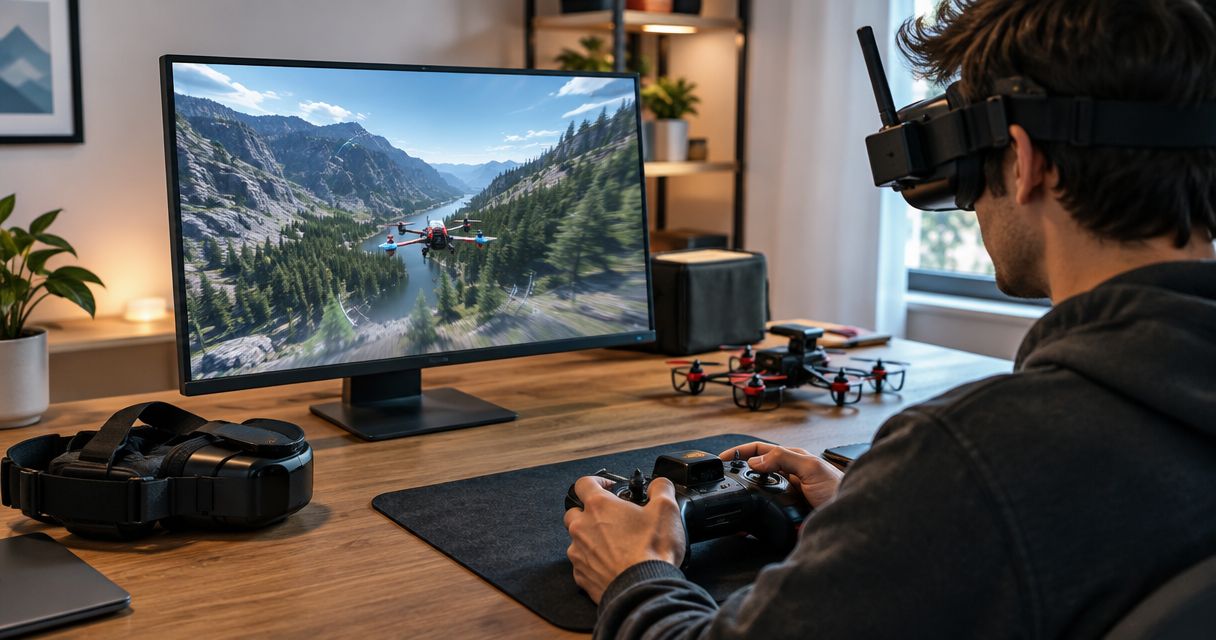
Liftoff is the best all-around FPV simulator in 2026, DRL Simulator has the clearest beginner learning progression, and VelociDrone is the essential race-practice tool when your real event track is available in the sim. TRYP and Uncrashed are the stronger freestyle alternatives; FPV Logic is the emerging option to watch.
TL;DR
- Liftoff wins overall among FPV drone simulators ranked by price, versatility, and proven player commitment.
- DRL Simulator is the best beginner pick because its tutorials build skills in a clear progression.
- VelociDrone is the racing pick for practicing MultiGP, MCS, and RaceGOW layouts before race day.
- TRYP is the high-quality freestyle pick; Uncrashed has the largest estimated active audience in the supplied PlayTracker data.
Why this matters
Crashing in a simulator costs nothing. Crashing a micro quad costs props, motors, frames, and stick time you do not get back. The right simulator lets you build throttle control, coordinated turns, gate lines, and Acro-mode muscle memory before real hardware enters the chat.
SquadFlight's Las Vegas fly nights and garage-lab meetups use simulator practice as a bridge to real flying, the same path that supports beginner FPV simulator training. If you are crashing more in the sim than you ever will on a real gate track, you are doing it right.
“If you are crashing more in the sim than you ever will on a real gate track, you are doing it right.”
What makes the best FPV simulator
-
Price position — whether the simulator sits at the budget, mid-range, or premium end once required content is considered
-
Learning progression — whether a new pilot gets structured lessons or is dropped into an open map
-
Flight purpose — racing, freestyle, cinematic lines, micro-FPV, or a mix
-
Real-track availability — whether you can practice the same layout you will race in person
-
Controller support — whether you can use a real radio and build transferable stick habits
-
Community activity — whether pilots are still flying, sharing tracks, and competing in 2026
-
Physics and tuning — whether rates, momentum, propwash, and quad setup feel useful for real-world practice
Prices change with sales, storefronts, regions, and optional content. The ranking therefore uses relative price position instead of freezing dollar figures that can go stale.
FPV drone simulators ranked by price and purpose
Simulator Best for Relative price position Standout feature Key limitation
Liftoff Best overall Mid-range paid Broad mix of freestyle, racing, tuning, and community content Dense setup menus for a first-time pilot
DRL Simulator Beginner progression Budget end Tutorials, missions, and structured race practice Small estimated active audience in the supplied 2026 data
VelociDrone Serious race preparation Premium racing setup Real event layouts, strong physics, track editor, and leaderboards Functional visuals and extra content can raise the total cost
TRYP FPV High-quality freestyle and cinematic flying Mid-range paid Large, visually rich environments built for flowing lines Less important than VelociDrone for real race-track rehearsal
Uncrashed Active freestyle community Lower-cost paid Large maps, drone tuning, and community-created environments Less structured for beginners than DRL Simulator
FPV Logic Emerging all-round alternative Mid-range paid Racing, freestyle, micro drones, and AI opponents Early Access and a much smaller measured audience
1. Liftoff: best FPV simulator overall
Liftoff remains the safest one-simulator choice for a pilot who wants freestyle, race practice, quad tuning, and community content in one package. Its Workshop ecosystem gives pilots a deep supply of maps, tracks, and builds, while radio support makes it useful for muscle memory instead of keyboard-only play.
The supplied PlayTracker snapshot reinforces that staying power. Liftoff has about 560,000 estimated players, 13,000 estimated active players, 25.4 hours of average total playtime, and 7.4 hours of median total playtime. Those are estimates, not Steam's internal figures, but Liftoff leads this supplied set in estimated total players and time invested.
Liftoff pros:
-
Best balance of freestyle, racing, tuning, and user-made content
-
Deepest measured playtime in the supplied PlayTracker comparison
-
Supports real radios for transferable stick practice
-
Large library for pilots who get bored flying one map
Liftoff cons:
-
Menus and rate tuning can slow down a complete beginner
-
It is not the default choice for practicing a named MultiGP, MCS, or RaceGOW event layout
Liftoff best for: pilots who want one simulator that can carry them from first Acro practice into freestyle and casual racing.
Verdict: Buy.
2. DRL Simulator: best for beginner learning progression
DRL Simulator should not be framed only as a cheap collection of official race courses. Its real advantage is the learning path: tutorials, missions, and time trials give a new pilot a sequence to follow instead of an empty map and a pile of settings.
That makes DRL Simulator the best first paid sim for someone who needs instruction. Pilots can build throttle control and basic turns before worrying about perfect rates or ranked multiplayer. Official DRL-style courses then give that practice a clear goal.
DRL Simulator pros:
-
Strong tutorial progression for pilots starting from zero
-
Missions and time trials turn practice into concrete steps
-
Official racing presentation keeps beginner drills engaging
-
Budget-end position lowers the barrier to structured training
DRL Simulator cons:
-
PlayTracker estimates about 1,000 active players from 427,000 estimated players in the supplied snapshot
-
Its 11.9-hour average and 2.7-hour median playtime trail Liftoff in the supplied data
DRL Simulator best for: new pilots who want the simulator to teach them what to practice next.
Verdict: Buy for your first structured training block.
3. VelociDrone: best for serious race preparation
VelociDrone is not just a premium multiplayer option. It is one of the most important tools in FPV racing because pilots can practice real layouts before arriving at an event. It is the official simulator for MultiGP, and its track editor and verified-track system also make it valuable for MCS and RaceGOW practice.
That changes the buying decision. If your next race layout exists in VelociDrone, practicing the exact gate order, line choice, and timing matters more than prettier scenery. You show up knowing where the track compresses, where to set up the next turn, and which line keeps falling apart.
VelociDrone pros:
-
Essential practice tool when the real event track is available
-
Official MultiGP simulator with track sharing and leaderboards
-
Popular for MCS and RaceGOW layout rehearsal
-
Strong racing physics, multiplayer, ghosts, and track editing
VelociDrone cons:
-
Visuals are functional rather than cinematic
-
The racing ecosystem and optional content can put it above simpler Steam purchases
-
Overkill if you only want relaxed solo freestyle
VelociDrone best for: pilots preparing for organized races or grinding the exact track they will fly in person.
Verdict: Buy if racing matters.
4. TRYP FPV: best for high-quality freestyle flying
TRYP FPV earns a main ranking slot because it approaches simulation as a freestyle and cinematic playground. Its large environments, visual quality, lighting, and long flowing terrain give freestyle pilots room to work on dives, gaps, proximity lines, and smooth transitions without being pulled back toward a race clock.
The supplied PlayTracker snapshot estimates 115,000 players and 6,000 active players, with 8.2 hours average total playtime and 3.2 hours median total playtime. That does not prove physics quality, but it confirms TRYP is a real hobby-FPV option with a measurable current audience.
TRYP FPV pros:
-
Strong visual presentation for freestyle and cinematic practice
-
Large environments support long, creative lines
-
Clearer use-case identity than a generic all-purpose simulator
-
Meaningful estimated active audience in the supplied 2026 data
TRYP FPV cons:
-
Not the first choice for reproducing a real race layout
-
Rich environments demand more from the computer than simpler sims
TRYP FPV best for: freestyle pilots who value visual immersion, large spaces, and flowing lines.
Verdict: Buy for freestyle.
5. Uncrashed: best for an active freestyle community
Uncrashed combines polished environments with freestyle and race practice, custom drone settings, and community creations. It is less prescriptive than DRL Simulator, but it gives pilots plenty of room to reproduce their quad feel and explore large maps.
Its activity figure is the surprise in the supplied data. PlayTracker estimates 279,000 total players and 31,000 active players, the largest estimated active audience among the five Steam titles supplied for this article. Average total playtime is 13.4 hours and the median is 4.4 hours.
Uncrashed pros:
-
Largest estimated active audience in the supplied PlayTracker set
-
Large, polished maps work well for freestyle exploration
-
Real-value tuning helps pilots approximate their own quad
-
Community environments and races extend the base content
Uncrashed cons:
-
Beginner progression is less guided than DRL Simulator
-
Average and median playtime trail Liftoff in the supplied snapshot
Uncrashed best for: pilots who want polished freestyle spaces and a visibly active current audience.
Verdict: Buy if community activity and modern environments matter most.
6. FPV Logic: best emerging all-round alternative
FPV Logic covers freestyle, racing, micro drones, tuning, and races against AI pilots. That breadth makes it interesting, especially for pilots who want to experiment with different aircraft types without committing to a race-only or freestyle-only simulator.
It is still the smallest option in the supplied PlayTracker comparison. The estimate shows about 25,000 players, active players displayed as 0K, 8.4 hours average total playtime, and 3.4 hours median total playtime. The 0K display means the estimate rounds below PlayTracker's shown thousand-player threshold; it does not prove nobody is active.
FPV Logic pros:
-
Supports racing, freestyle, and micro-drone flying
-
AI opponents make solo race practice less empty
-
Detailed setup options suit pilots who enjoy tuning
FPV Logic cons:
-
Early Access means features and feel can still change
-
Much smaller estimated player base than the established picks
-
Limited measured activity makes community depth harder to judge
FPV Logic best for: pilots who want to try an emerging all-round simulator and are comfortable with Early Access.
Verdict: Hold unless its specific drone mix or AI racing appeals to you.
Player activity and playtime comparison
PlayTracker estimates are directional audience signals, not official sales or live-user counts. The figures below were supplied from PlayTracker on September 22, 2026; VelociDrone is excluded because no comparable PlayTracker snapshot was supplied.
Simulator Estimated players Estimated active players Average playtime Median playtime
Liftoff 560K 13K 25.4h 7.4h
DRL Simulator 427K 1K 11.9h 2.7h
Uncrashed 279K 31K 13.4h 4.4h
TRYP FPV 115K 6K 8.2h 3.2h
FPV Logic 25K Below 1K displayed 8.4h 3.4h
The clean read is not that one number crowns a winner. Liftoff has the largest estimated lifetime audience and deepest playtime; Uncrashed has the highest estimated active audience; DRL has broad historical reach but lower estimated current activity. Use those signals to judge community momentum, then choose by the skill you actually need to build.
How we ranked
Each simulator was judged on relative price position, learning progression, racing or freestyle fit, real-track availability, controller support, community activity, physics, and tuning. Price breaks ties; purpose decides the winner. A cheaper simulator is poor value if it does not train the kind of flying you plan to do.
Which FPV simulator should you choose?
Choose Liftoff if you want one safe all-around purchase. Choose DRL Simulator if you are new and need a guided progression. Choose VelociDrone if you race MultiGP, MCS, RaceGOW, or any event whose real layout can be loaded in the simulator.
Choose TRYP FPV for high-quality freestyle and cinematic lines. Choose Uncrashed for polished maps and the strongest estimated current activity in the supplied set. Treat FPV Logic as the emerging alternative, not the default recommendation.
Once you can hold a line and clear gates consistently in Acro mode, move from the simulator into supervised real-world practice. SquadFlight's guide to FPV goggles for beginners covers the next gear decision without pushing beginners into an expensive digital setup first.
FAQ
What's the best FPV drone simulator in 2026?
Liftoff is the best overall FPV simulator in 2026 because it balances freestyle, racing, tuning, community content, and long measured playtime.
Which FPV simulator is best for a complete beginner?
DRL Simulator is the best beginner pick because its tutorials, missions, and time trials create a clear learning progression instead of dropping you into an empty map.
Why is VelociDrone important for FPV racing?
VelociDrone lets racers practice real event layouts, including MultiGP tracks and community-built MCS or RaceGOW courses, before flying them in person.
Is TRYP or Uncrashed better for freestyle?
TRYP is the stronger pick for large cinematic environments and flowing freestyle lines; Uncrashed is better if you value polished maps, tuning, and a larger estimated active audience.
Does simulator practice transfer to a real FPV drone?
Yes. Throttle control, stick coordination, line choice, and gate timing transfer, especially when you use a real radio and match your rates closely.
Are PlayTracker player counts official?
No. PlayTracker figures are third-party estimates, not official Steam sales or live-player totals, so they should be used as directional audience signals.
Should I buy a simulator before a real FPV drone?
Yes. Simulator time lets you build Acro-mode control and crash repeatedly without breaking props, motors, frames, or a beginner budget.
One last thing
The most realistic simulator is not automatically the most useful one. A beginner improves faster with DRL's progression, a freestyle pilot gets more from TRYP's open environments, and a racer gains more from flying tomorrow's exact track in VelociDrone. Buy for the next skill, not the longest feature list.